
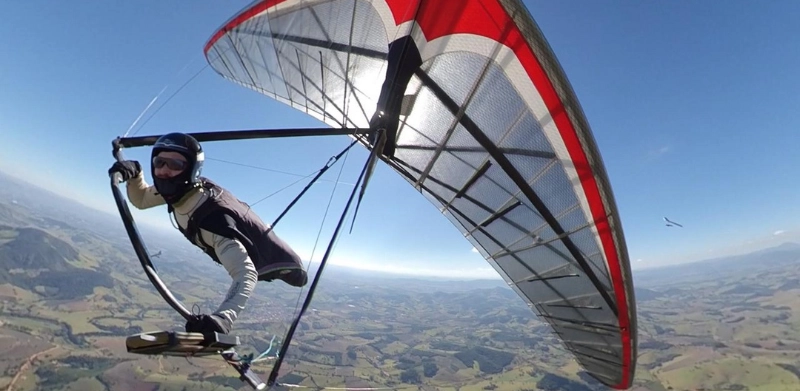
My love of hang gliding took me on a quest for endless summers – chasing summer in Europe, then heading Down Under to catch it again. The pinnacle of flying hang gliders is going cross-country: flying from thermal to thermal, using these columns of rising warm air to cover distance over the ground. This could be through the high, dramatic mountains of the Alps, or over the relatively small creases in the landscape – more commonly known as hills.
Sometimes you could climb to 4,000 m AGL (Above Ground Level). This height would vary day to day depending on weather systems and whether the sun had “got his hat on,” since all the lift comes from the sun’s energy. That in itself is a science of understanding.
Anyway, meteorology lesson over – now on to one of my more memorable flights. It involved an interesting interaction between eagle and hang glider pilot (me). We love to emulate birds; in the early days of hang gliding, we were sometimes referred to as “bird men.” In a practical sense, birds help us see these invisible, elusive columns of rising air. In our perpetual search for lift, we look for and fly toward birds circling in the sky. Nine times out of ten, they’re using thermal lift to rise to the clouds, and we want in too – so we fly to where they are and hitch a lift.
YOU KINDA SEE THE THERMAL IN YOUR MIND’S EYE AND CATCH A TICKET TO THE SKY.
Many times I’ve shared thermic lift with the most majestic of these beasts – eagles. But one day it got rather interesting. The story happens in two parts.
Part One
There’s a species of eagle called the Wedge-tailed Eagle, found in Australia. These eagles can have a wingspan of up to 2.5 meters. We know them as great thermal indicators in Australia, but some have pretty bad attitudes. They can be very territorial and aggressive. Most of the time, they just ignore us flying through their airspace, but occasionally they act like aerial hooligans – making irritated squawks as if to shout “F*** off!” They’ll fly behind you, squawking, as if to tell you to get the hell out of their patch.
One year, around the time of the World Championships, which were held in Bright, Australia, there were several reports of eagle attacks on hang gliders. The eagles were obviously pissed off with hundreds of gliders invading their airspace. It was like they were protesting in an organised manner. They’d either attack the wingtip or the nose of a hang glider, often leaving tears in the fabric. Feisty little devils.
That year, I had the experience of being attacked by a well-known eagle. The site was called Murmungee, in the Bright area – home to Mount Buffalo. It’s a breathtaking launch site, where takeoff involves running down a 15-meter ramp over a 1,000-meter vertical cliff. (I’ve got another near-death story from that launch, but back to Murmungee.)
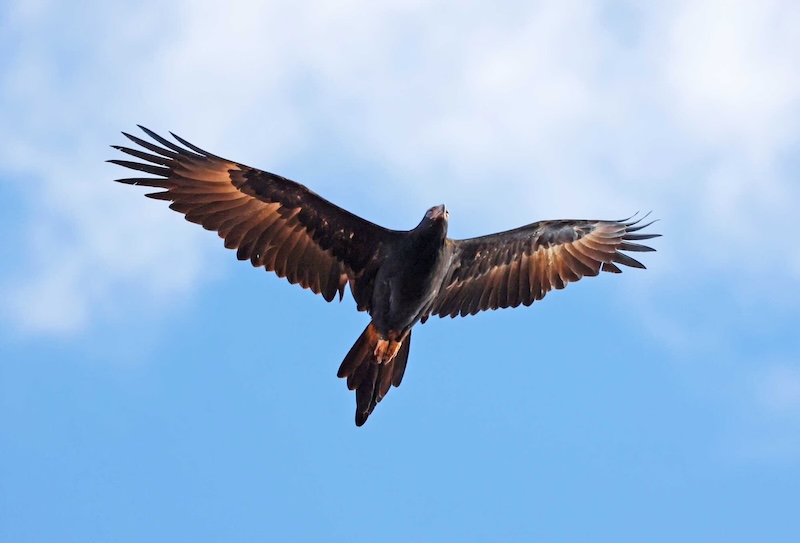
This flying site has the nickname “Murdering Budgie,” thanks to the reputation of a very territorial and grumpy Wedge-tailed Eagle living there.
One day I took off from there and was flying low over the trees, trying to find some thermal lift to begin a cross-country flight. At this point, I was low and searching. I looked for all the usual indicators – the leaves shaking as thermals ripped away from the ground. You’re always 100% wired. I was maybe 50 feet above the tree-covered hill, searching for that lift to take me high and set me on a long, pleasant journey.
You need to find that thermal, or you’ll float down to the dreaded “bomb-out” paddock within minutes – the paddock of shame. It’s the difference between flying for hours or landing at the bottom of the hill in defeat. And you’re dressed in thermal gear because, if (or when) you catch a thermal, you’re propelled into much colder air. Problem is, if you do bomb out, you’re standing in a hot Australian paddock in 37°C heat, dressed like you’re headed for a polar expedition.
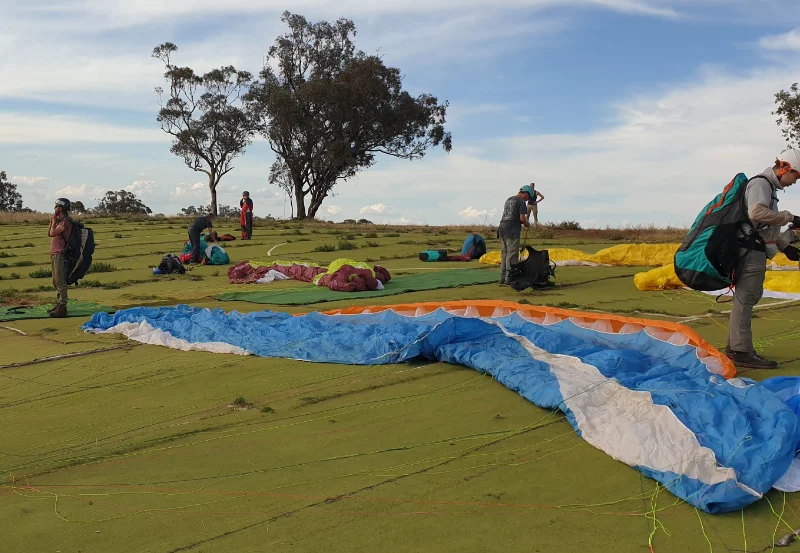
So, there I was, scratching around (the term for flying low and close to the hill), just above the treetops, waiting for a good thermal cycle. First, the sun has to heat a patch of ground – ploughed fields heat up more than shaded areas. That ground then heats the air above it, and a bubble of warm air builds up until it eventually breaks free and rises skyward.
I was working hard, using every bit of lift, waiting for the big one. It’s quite physical turning a hang glider. You steer by shifting your body weight – left to go left, right to go right, forward to go faster, and back to go slower.
When scratching for lift, you’re constantly turning near the hill. You might feel lift under the right wing, and the glider wants to naturally turn left, away from it – but you want in, so you heave your body right, into that rising air. After a while, it gets sweaty work.
That day, I was working hard, staying low – and I caught the attention of the local Wedge-tailed Eagle. This Wedgie was not happy to see me.
He flew just above and behind me, squawking. Then, with a thud, the kamikaze eagle screeched and sank her talons into my glider – right around the nose area. I felt the glider shudder with the impact. I made a beeline to the bottom landing paddock and landed. I was kinda pissed to be overdressed in a hot paddock, but also – how many people can say they’ve been attacked by an eagle?
I unclipped from the glider and walked around to inspect it. Yep, I’d been got – a 20 cm tear in the fabric.
Part Two
Now, Wedge-tailed Eagles tend to stay in the same territory – they’re very territorial creatures. A year later, I was flying the same site, but this time I’d caught my thermal ticket and was climbing high, maybe 2,000 or 3,000 feet above the hill, as happy as Larry (whoever he was, he must’ve been a very happy chap).
Then I saw that eagle – the one who’d ripped my glider the year before. He was riding a thermal up beneath me, spiralling fast and catching up.
Without much thought (or, honestly, any thought at all), I decided I’d teach him a lesson.
At the time, a hang glider’s speed range was between 20 and 60 mph. At the top end, you’re basically diving out of the sky – losing height fast and feeling very alive. I pulled the bar to my knees and dove toward him, hooning down like a madman. Within seconds, I was on top of him, gave him a proper scare – and then he disappeared from view.
Next thing I heard was him screeching above me. So once more, I dove toward him, and every so often, I’d push hard on the control bar to make the glider rear up, trying to bat him away. I hadn’t really thought it through – it was like I was a budgie and he was the Red Baron flying ace.
This went on for several thousand feet as I spiralled down. Eventually, I levelled out about 300 feet above the ground. No sign of my aggravated aviator.
Then I looked to my left wing – and there he was. He looked majestic. His wingspan seemed as long as my left wing. His talons were drawn, and he stared at me, as if to say, Don’t be f*ing with me, boy.
He hung there a moment longer, then – blink of an eye – he was gone.
I’d lost all my altitude, and my flying day was over. Once again, overdressed and on the ground. That was the last time I flew that site.
I hasten to add: being attacked by an eagle is highly unusual. They’re usually peaceful aviators. And, of course, my own stupidity in trying to “teach the bird a lesson” didn’t help.
The only upside? It makes for one hell of a story.