
Another life ago, I was the champion of my situation. I had just opened a school teaching paragliding. At the time, paragliding was a very new sport – a parachute that could fly like a hang glider and do more or less the same things. It was a tiny revolution in free flight – the ability to soar like a bird and have your wing fold up into a sack you could easily carry on your back.
Hang gliding was a very marginal sport practiced by what the press portrayed as a bunch of stoned hippies. By the 1980s, it had become much safer, but it still carried the bad reputation from the 1960s and 1970s when there were a few teething problems that unfortunately bent a few practitioners. Then paragliding arrived, and because I was already a hang gliding instructor, the sideways move was simple. I opened my school just as all the yuppie windsurfing types saw a new adrenaline rush on the horizon – but it had to be safe because it was a parachute, right? Not exactly, but that’s another story.
By the late ’80s, I was enjoying a certain notoriety that fueled a great little business. I met lots of people with imagination and the money to pay for it. My school was in Swansea, Wales, just 40 minutes south of the rugged Black Mountains and on the Gower Peninsula. Here, we could fly over the beach at Rhossili, sometimes soaring 1,000 feet above a beautiful sandy shore. It was all fine and good in the summer, but the winter was mostly windy and wet – no good for paragliding.
So, I came up with the idea to guide and teach people in the French Alps – to do adventure holidays. The concept of Ski Volair was born. I could handle the guiding and teach alpine flying, but I needed someone on the ground to book flights and secure clients. How was I going to do that? I needed money, infrastructure, and someone to run an office. Problem: I didn’t have two pennies to rub together, but I had an idea.
Then I heard about these disabled individuals who could be sponsored by the government to work. It seemed like a win-win – I could get what I needed done and employ someone who might otherwise struggle to find work. I got a name and address of someone who might fit the bill, and that’s how I went to see Ian Hughes.
Ian lived in an institution with maybe 20 or so disabled people in a town called Llanelli. It doesn’t sound anything like it’s spelled and involves sounds we don’t usually make unless we’re trying to clear mucus from our throats. The Welsh would sing it rather than say it.
Going into the Institution
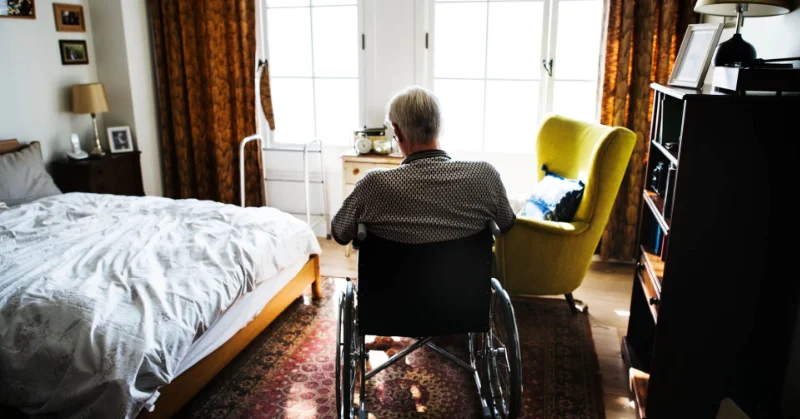
I made an appointment to see Ian. I had never encountered any seriously disabled people before. I had heard of conditions like MS, MD, and cerebral palsy. I had heard the word “cripple” but had never actually seen someone with severe disabilities up close. I strolled into the institution, made my way to reception, and suddenly, I was among them – arms flailing, indecipherable noises approximating speech, distorted bodies in wheelchairs. Some stared at the walls, actively doing something – I wasn’t sure what, but something. I was way out of my comfort zone.
After my initial shock had abated, I spoke to the secretary and asked to see Ian. I was led down a couple of sanitised corridors and introduced to him. Ian was calmly and timidly lying on his bed. He could speak clearly, and after a few minutes, he opened up. We chatted, and I told him what I was looking for. He was competent on those primitive computers, and he had a soft Welsh accent. Although he was painfully shy, he agreed to give it a go.
With the business stuff out of the way, I helped him into his wheelchair, and we went to the kitchen where I could make some coffee and meet some of his friends. I was feeling more at ease with them now, and I made some coffee and talked, where possible, to various people with varying degrees of impairment.
I made a coffee for one of his friends who couldn’t speak in a manner I could understand. She had quite advanced multiple sclerosis and lay limply in her wheelchair. I had to help her drink it, and I was nervously holding the sipper cup to her lips when she said something. I had no idea what she said, but everyone around us roared with laughter. I turned to Ian with a confused expression and asked what everyone was laughing at. It turns out she had asked me to fuck her – her idea of a joke! I now felt totally awkward. Everyone continued to laugh, and I was now the odd one out. I scuttled out of the institution and started to work with Ian.
Ian was really shy and had simply met only a handful of people in his life. The past 10 years had been spent in an institution. Step one: get him used to using a phone and talking. For about a month, I got a bunch of my friends and paragliding students – who usually became friends – to call him up on a phone we had installed for him in his room. No mobile phones yet! Little by little, we worked out a booking system, and he started running Ski Volair, all from his room. We were never big; at our peak, we moved 10 to 20 people a week over a 5-month ski season and 10 a week for a 2-month summer season.
After a few months, Ian moved out of the institution into an assisted living situation in his own house, where people would come in to wash, dress, and feed him, and then he would go to the office. He was now independent – at least as independent as he could ever be.
The Office
I spent much time with Ian talking about my life and his – polar opposites. I listened to him as he waxed lyrical about his memories of running on the beach, feeling the sand between his toes. He hadn’t always been confined to his motorised chariot. With muscular dystrophy, one is born “normal.” It comes on slowly and insidiously, weakening and eventually paralysing the sufferer. There are many types. Ian and his two brothers had a severe form that would eventually rob them of their lives all too early – around 40 years, the average lifespan for this condition. Three brothers, all with MD – they really lucked out on the genetic roll of the dice.
Ian’s New Home
Ian soon moved away from the institution and got an assisted living house, coming to work on a daily basis. In some ways, he lived a vicarious life. He had made friends on the phone with my clients, and I would tell him stories of flying paragliders in the French Alps. He became the main man on the phone at the Ski Volair enterprise, organising flights and taking bookings. He developed a close relationship with my – no, I should say our – clients.
 That enterprise lasted for two or three years before I went bust. The French franc had just leaped 20% in value, while the good old pound sterling dropped 20%, which meant the money my company, Ski Volair, earned in the UK was worth half as much when I had to pay rent in France. I was technically done for. So, I had to say goodbye to Ski Volair and stayed in France, working as a paragliding instructor.
And as for Ian? There was no more reason to go back to Wales, where I had started my paragliding journey. I lost contact with Mr. Ian Hughes. As time passed, I would periodically try to get in touch with him, but I never managed to reconnect. In those days, with just phones for communication, we lost sight of each other.
About twenty years later, I found myself thinking about him. I thought to myself that the chances were he was dead by now. MD sufferers don’t usually live that long, often because the muscles needed for breathing give out, leading to slow asphyxiation. Resigned to this, I went about my life. Then, one day, I received an email – from Ian himself. Yes, Ian was still alive, and he had reached out to me. That would make him around 50 years old. Man, I was so excited.
I Skyped him that night. I was living in New Zealand, and with the time difference, I called him at 11 a.m. Welsh time. It turned out he had spent the last ten years confined to bed, using a respirator because his chest muscles were so wasted that he needed mechanical help. Every few weeks, he would endure some sort of agonising pain that couldn’t be medicated. Ten years of getting worse and worse. Why he hadn’t lost the will to live was beyond me.
We, of course, became friends on Facebook, and you can measure a man by what he posts. All his posts showed concern for the welfare of animals. He hated cruelty and suffering. Ironically, Ian personified suffering. We talked about his halcyon days with Ski Volair. He told me they were the best days of his life – well, that wasn’t hard to believe, was it?
We remained in contact for about six months until I got an email from his brother, Alan, informing me of Ian’s passing.
Twenty years on, and I am now working with the disabled and those with special needs. Funny enough, I get more satisfaction making music with special needs individuals than I ever did swanning around in the air. Thank you, Ian, for your introduction to another way of life.