
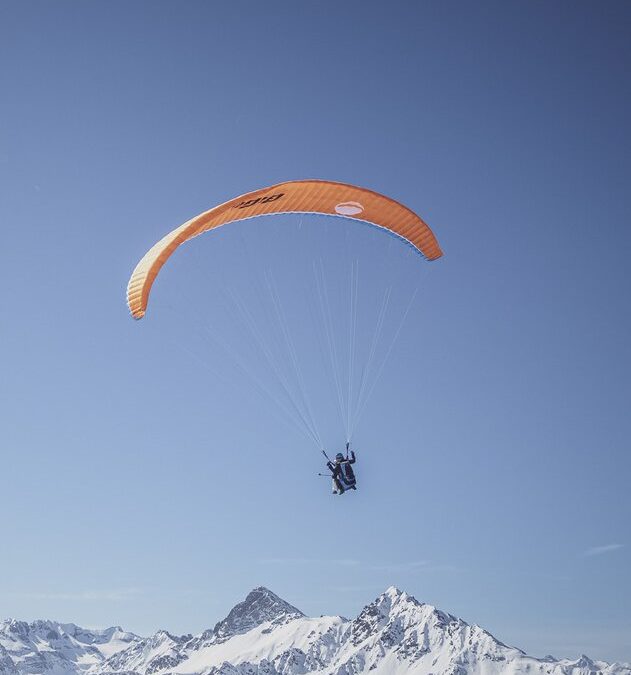
Do you know the story of Icarus? It comes from Greek mythology. Icarus fashioned himself wings from feathers and stuck them to his arms with beeswax. This strategy worked – and worked very well – but Icarus flew too high, too near the sun. The sun melted the wax, the feathers fell off, and Icarus plummeted to his death in the ocean. He ignored the laws of physics and died because of it.
In my case, with a gossamer paraglider wing, the laws of physics were also obeyed – right up until the suspension lines exceeded their breaking point, sending me hurtling toward Earth at a great rate of knots. The difference between my story and Icarus’s is that I lived, and he didn’t. The fact that I survived wasn’t due to any particular skill of mine, but sheer good luck – maybe even divine intervention. And this is coming from a non-believer.
One of my luckiest breaks was getting into paragliding from its very beginning. A fabric wing that could fly like a hang glider, yet could be packed into a bag and carried on your back to your car. A hang glider is a massive structure – you can fold it up, yes, but it must be transported on a roof rack and weighs 30 to 40 kilograms. A paraglider, with its harness, packs into a rucksack weighing about 12 kilograms.
Public opinion of hang gliding was pretty negative. According to the media, it was invented by a bunch of pot-smoking hippies, and the few crashes that occurred were portrayed as the norm. So, everyone assumed hang gliding was for loonies. Like all stories, there was a kernel of truth.
Hang gliding emerged in the 1960s from two directions: NASA and the Apollo space program. Francis Rogallo designed the first triangular steerable wing structure for the Earth landings of the Apollo missions. This idea was eventually superseded by parachutes. That curious triangular shape was noticed by some free-spirited Californians, who built copies out of bamboo and polythene, launching them from hills. The results were… variable. Mostly, they didn’t get very high, so the crashes weren’t too bad. But as hang gliders started flying higher, the accidents grew more serious, and unfortunately, more frequent.
At the same time in Australia, people were using kites to take off on water skis. There were accidents there too, but fewer serious injuries – they crashed into water, after all.
The media left its scar on the fledgling sport of hang gliding. “Hippies and loonies, the lot!” Circa 1960s–1970s.
By the 1980s, hang gliding had become a very safe and regulated sport, with a safety record better than horse riding. Then paragliding started, and everyone thought, “It’s a parachute, so it must be safe.” How wrong they were…
What really made paragliders work was a major design change – suddenly, they had enough performance to fly like a hang glider.
Thousands of people jumped into paragliding. This flying machine could be packed into a rucksack! At that time, I was already a competent hang gliding instructor. Right place, right time – and I made the most of it. Hang gliders and paragliders do the same thing; they’re just different flying machines. I started a large paragliding school in South Wales: The Welsh Paragliding Centre.
We measure performance in terms of glide angle – how far forward you fly compared to how far you descend. A glider might be 50:1, a hang glider around 12:1 (12 meters forward for every meter down), and a paraglider maybe 3:1.
Before that, early attempts at hill flying with parachutes or first-generation paragliders resulted in simple top-to-bottom flights. A couple of minutes at best. Hang gliders, meanwhile, could take off, soar in front of the hill, land at the top, or catch thermals and go cross-country.
This new generation of paraglider could float up and down in front of the hill, just like a hang glider. It became a magnet for all the yuppies who were into sports like windsurfing, skiing, water-skiing, etc. – sports that required a bit of cash and had a certain “cool” factor. It was a great show-off sport.
“Yes, I’m a paraglider pilot, baby!”
Paragliders looked like butterflies – bright, beautiful, and (supposedly) not as dangerous as “that crazy hang gliding.” Ignorance is bliss.
I loved that I had a thriving business, and I got to do a few paragliding competitions – maybe even win something. But the best thing about competitions is that you learn, you push your flying envelope, and your name becomes more well-known – which makes commercial sense. Later, with the internet, that recognition even helped me recover from a coma I was in… but that’s another story.
I became involved in flying new prototypes – or often, copies of other paragliders that were tweaked for better performance. They tried to make the wings thinner and longer, like those of an albatross or a glider – the ultimate flyers. They reduced drag by decreasing the diameter of suspension lines and by redesigning the suspension layout to use fewer meters of line. Less line, less drag.
I wasn’t a proper test pilot – frankly, I’m not sure there were any proper test pilots back then. The sport was just so new. Eventually, organisations emerged to set standards. Now, paraglider testing is incredibly well done. Minimum standards for pilot qualifications were established, and yes – you now even need a license.
⸻
St. André-les-Alpes
The pre-Worlds were scheduled in the late ’80s at Saint-André-les-Alpes in the southern French Alps. I was due to represent the UK and was feeling great. Competition tasks usually involve flying a cross-country route with several turn points – anywhere from 20 to 150 kilometres, and it might take 2 to 4 hours. The tasks vary depending on conditions. For example, strong winds favour open distance flights – flying as far away as possible from the starting point. At that time, distance records were in the 200–300 km range. Now it’s 612 km!
On a light wind day with a high thermal base – that’s how high the thermals will take you – you might fly a triangular course and return to your starting point.
Day one: I stood atop a small mountain with about 100 others milling around. Pilots had their paragliders bunched and slung over their shoulders. The atmosphere buzzed – vibrant, multilingual, electric. Officials moved about with walkie-talkies, organising everything.
My turn. I stepped forward. Two guys spread out my glider. I grabbed the front risers and tugged – my paraglider sprang to life, inflated in the mountain breeze, and sat obediently above my head. A beautiful wing: bright blue with red tips.
A few brisk steps, and I was airborne.
Sometimes, wingtip to wingtip with others, all of us trying to out-climb one another. I caught the resident thermal, circling in rising air, climbing fast toward the developing clouds. The lift was strong that day. The whole mountain pushed air skyward. I simply followed the ridge line and was lifted thousands of feet into the sky.
****, this is good! First turn point down – onto the next. Unbelievable buzz. Looking down on massive mountains, then up at your bright, colourful wing. I still had moments of awe. “I’m thousands of feet in the air… under this bag of washing!”
Then I misjudged my glide and ended up low behind smaller ridges. The valley wind made the air turbulent – like whitewater rapids, swirling and chaotic. The “washing machine” effect began. My wing danced, tips deflating and re-inflating with loud cracks.
Suddenly, I started to spin.
“That’s weird,” I thought. “There’s no reason I should be spinning.” I was rotating around my own axis. A very strange feeling – usually, you have to induce that yourself. I glanced up.
The glider looked wrong. Normally, a tip fold can be corrected – opposite steerage, pump the wing out. But this was different. The glider was folded backwards, and it wasn’t recovering.
Then it hit me – my suspension lines had broken. Everything on the left had snapped. My glider would not recover.
Worse yet – I entered a spiral dive. Half the wing was now just a flapping bag of washing. In a spiral, you lose altitude fast – not quite freefall, but close. Impact at that speed? Game over.
Now, we fly with reserve parachutes for this very reason. If your glider becomes a tangled mess, the reserve gets you safely to the ground. Usually it’s a round parachute that you throw out – it inflates, and you drift to the ground in a heap, usually unhurt.
But I wanted more. I wanted a steerable safety parachute. So I turned to the parachuting world.
I took a basic parachuting course – three jumps and a lot of theory. I was a complete novice, but being the idiot I am, I thought: “Great, I get it. Let’s get a square reserve for paragliding!” I bought a parachuting reserve and harness and adapted it.
In parachuting, if you deploy above 1,000 feet AGL, you cut away your main. Pull the right handle, the main falls away, and as it drops, it pulls the reserve open. Below 1,000 feet? You do a canopy transfer. Deploy the reserve first, let it inflate, then cut away the main.
At the time, I didn’t realise this was a very advanced manoeuvre. But as I said – the line between brilliance and stupidity is very thin. And I was on the wrong side.
Spinning, falling – “Below 1,000 feet AGL,” I thought. “Canopy transfer.”
I pulled the left handle. I expected something explosive – a parachute to bloom. Instead, a small white drogue chute appeared, meant to pull the reserve out. It wrapped itself around me as I spun.
I fell toward the Earth, trussed like a chicken.
Last thoughts.
Everything was out of focus. I thought, I’m going to die. I just hope it doesn’t hurt too much. I expected a bright white flash – like when you get hit on the head – and then infinite black.
I squeezed my eyes shut
⸻
Then I opened them.
I was sitting, perfectly upright, on the ground. Legs straight out in front. My safety parachute sat neatly folded by my left thigh. It had finally deployed – after I’d landed. Still neatly folded. I looked around – realised I’d fallen through a tree. I moved my legs. Both worked. All good.
I stood up and began pulling my glider from the branches.
What I think happened: I crashed through the tree. The glider snagged on branches, slowing me from hell’s speed to a snail’s pace, gently depositing me on the ground with astonishing grace.
My only injury? A superficial scratch on my leg from a prickly plant while retrieving my glider. About five centimetres long.
WTF.
The few eyewitnesses were in awe. It seemed unbelievable that the gormless Englishman had just walked away from a fall like that.
⸻
The rest of my paragliding career was spent teaching and doing tandem flights. It was a beautiful career.
Years later, I was telling this story to Jude, the son of my good Evangelical Christian friend. We’ve been arguing theology for forty years – never agreed, but still great friends.
As I finished telling the story, Jude looked me square in the eyes and said,
“And you don’t believe in God?”