
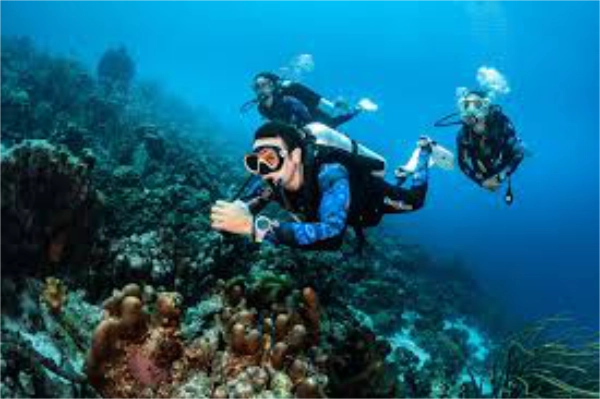
My first love was being under the sea. As a kid, I was an avid snorkeler. I lived by the sea on the south coast of England and would dive as deep as I could until I went too deep and burst an eardrum. I didn’t know about clearing your ears as you descended under the waves – man, it was painful.
Then someone told me to see this guy named Frank Martin. Apparently, he knew all about that stuff, so I found out where he lived and cycled over, probably unannounced. There I found a sixty-something-year-old man – an amazing man, to cut to the chase.
He had served in World War II as a marine in Italy. He had a massive house littered with stone carvings and endless sheds filled with all sorts of things. He was a diver – one of the very first to dive with an aqualung. Before the 1940s, if you wanted to dive, it meant suiting up in a heavy waterproof diving suit with hefty boots and a brass helmet. You would be lowered to the ocean floor – not very deep, as air was pumped from a boat to the submerged diver. You needed heavy boots to laboriously walk on the bottom. Then another amazing man, Jacques Cousteau, invented the aqualung.
 Cousteau’s book, The Silent World, is well worth the read. It describes how he went about designing and testing the aqualung. I’m quite surprised that they mostly all survived. His aqualungs had two thick hoses coming from the bottle of compressed air on the diver’s back. Today, we have just one hose leading to the mouthpiece, but it works on the same principles. Frank made his own aqualungs – you couldn’t just buy that stuff after the war. In his shed, he had the remnants of his homemade aqualungs. He tackled problems head-on and usually solved them; I guess he influenced me in a big way. No problem was too big for him. He taught me spearfishing. I wasn’t very good and didn’t see many fish, so my tally was just one.
Frank also built his own inshore rescue boat. He had a gripe about the RNLI, the established inshore rescue organisation of the UK. He claimed that all of them came from fishermen and that none of them could swim. His idea was to man his rescue boat with swimmers in wetsuits who could quickly deploy and race off to rescue others. It was great fun because I got to jump off the boat at speed in a wetsuit. We only ever practiced, and I was never present for a real rescue, but it was thrilling to practice jumping off a racing rescue boat. After all, I was only 12 years old.
I carried on and learned to dive properly, eventually becoming a kind of instructor – what we called a dive leader. I ended up at Swansea University studying Marine Biology and was a regular diver in the freezing, murky Welsh waters. I have one dive that is unforgettable and nearly cost me my life.
There are a whole bunch of things you need to know and understand to dive safely. Most people have heard of “the bends.” If you come up too quickly from depth, it can cause excruciating pain and even death. Just like when you open a can of fizzy drink, bubbles escape. The same thing happens in your body if you ascend too quickly – bubbles form inside you, causing great pain and potentially death. You need to be recompressed and then slowly decompressed. Every 10 meters you descend, the pressure doubles.
Another issue is with nitrogen. This became a problem for me on one particular dive – nitrogen narcosis. The increased nitrogen dissolved in the blood can lead to altered consciousness.
In order to breathe at depth, you need to inhale air at the same pressure as the water pressing on your body. Every 10 meters, the pressure doubles. So, at 40 meters depth, you are breathing air at four times atmospheric pressure. It follows that more air will dissolve in your blood. When too much nitrogen – comprising 79% of the air we breathe, with the remaining 20% being good old oxygen – dissolves in your blood, it can become toxic. The first signs of this toxicity are cognitive issues, a kind of drunkenness. In my case, it wasn’t much fun!
We were diving on the southwest coast of England with the university dive club, and I was diving with another chap on a wreck at 42 meters. This was a fairly deep dive at the time. I had broken one of the cardinal rules of diving because I lost sight of my dive buddy. You always dive in pairs. I got so interested in exploring the sunken wreck that I completely lost sight of him. Anyway, I swam into a room to take a look around. It was a small room, just a few meters by a few meters. I could feel my aqualung knocking against the sides of the room.
 It was a bit of a squeeze, and then I became snagged – stuck like a fish on a hook. This is where nitrogen became a problem. I slipped into nitrogen narcosis. I started to feel very paranoid and scared – so scared that I wanted to panic. The nitrogen narcosis had turned a bad situation much worse.
My brain wasn’t thinking straight. It seemed to be saying, “Panic!” In fact, panicking seemed like the right thing to do. I was filled with fear, and as I moved within the sunken cabin, I kicked up a lot of silt, which filled the room, making it hard to see.
In my head, it felt like I had two voices talking to me. One said, “Panic! You must panic!” – and it felt right. But the other voice said, “If you panic, you are dead.” So, I listened to the second voice, even though, paradoxically, panicking felt like the natural response. Somehow, I made the right choice.
I had to see why I was so snagged. Every time I moved, I was stopped – like a fish on a hook. I needed to perform a very simple manoeuvre, something that in a swimming pool or under no stress would be easy. But in my panicked, cognitively impaired state, it seemed daunting. I carefully unbuckled my aqualung and found that some netting was caught on my tank. I simply untangled it. I was free – now it was time to get the hell out of there. I noticed a light area in the murky, dark room, which turned out to be a hole in the side of the ship. I pushed my aqualung through the hole and swam out after it.
The whole experience probably only lasted about five minutes, but it seemed like a lifetime. It nearly cost me my life.
I love diving, but my new passion was taking control – hang gliding became my new “drug.” In both sports, you are effectively weightless.
I grew a little disillusioned with marine biology. Most of my dive time in the field involved counting bivalves in zero visibility, diving in conditions where I could barely see my hand in front of my face to collect data whose relevance I struggled to see. I had grown tired of zero-visibility dives and taking off my wetsuit in freezing conditions. It was not about feeding and petting dolphins.
So, I dropped marine biology and became a straight biologist with a penchant for pathology in cell biology. I’ve dived a few times since then, the best experience being at the Poor Knights in New Zealand – diving through submerged arches and watching majestic manta rays gliding effortlessly through the water.